From ZEUS let us begin.
Him do we mortals never leave unnamed:
full of Zeus are all the streets
and all the market-places of men
full is the sea and the havens thereof.
Always we all have need of Zeus
for we are also his offspring
and he in his kindness unto men
gives favorable signs
and wakens people to work.
-- Aratus (270 BC),
The goal of the Emerging Church is to reach the post modern generation. The movement has attempted to do this by making Christianity relevant to the culture - that is by preaching and teaching truth in a way that is native to the understanding of the new generation.
Some traditional Christians have criticized this movement as misguided, unscriptural, and of man. I believe, however, that the goals and methods of the movement are both legitimate and scriptural.
When Paul preached in Athens (Acts 17:22-31) he modeled how to preach to pagans. He did it by being relevant - by finding common ground and understanding with his audience. Paul presented Christ in a way that was familiar to the culture of the Greeks.
Acts 17:22 Paul then stood up in the meeting of the Areopagus and said: "Men of Athens! I see that in every way you are very religious."
Paul went to the Areopagus (their center of learning in Athens), and engaged the Greeks in their environment. He didn't demand that they go learn about God in the synagogue (and there was one in Athens). He didn't complain that they ignored Jewish law. He didn't insult their religion.
23: For as I walked around and looked carefully at your objects of worship, I even found an altar with this inscription: TO AN UNKNOWN GOD. Now what you worship as something unknown I am going to proclaim to you.
Paul understood his audience. He took an aspect of their pagan culture (the unknown god), and used it as a way to proclaim Jesus Christ to them.
24-27: The God who made the world and everything in it is the Lord of heaven and earth and does not live in temples built by hands. And he is not served by human hands, as if he needed anything, because he himself gives all men life and breath and everything else. From one man he made every nation of men, that they should inhabit the whole earth; and he determined the times set for them and the exact places where they should live. God did this so that men would seek him and perhaps reach out for him and find him, though he is not far from each one of us.
Wham! Now that the ground was laid, Paul hit them with 100% Gospel. The truth was not watered down. He explained who God is. He explained how God is real, and how God is not honored with idols made by human hands.
28:For in him we live and move and have our being. As some of your own poets have said, 'We are his offspring.'
Look at that little phrase "We are his offspring." It's easy to overlook, but it is SO important to understand the context of how Paul preached to the Athenians. This quote was NOT from the Bible. It was Greek poetry, and it in fact referred to Zeus. Paul taught the Greeks about Jesus by quoting a pagan poem about Zeus!
29-31: Therefore since we are God's offspring, we should not think that the divine being is like gold or silver or stone—an image made by man's design and skill. In the past God overlooked such ignorance, but now he commands all people everywhere to repent. For he has set a day when he will judge the world with justice by the man he has appointed. He has given proof of this to all men by raising him from the dead.
Now Paul shows how the nugget of truth contained in their poetry ("We are God's offspring.") differs from what they are actually practicing (worshiping man made images). After showing them their error, he tells them that they must repent. And he explains that they will be held accountable before God.
Every culture (including ours) has nuggets of God 's truth in it, just like Greek culture did. These nuggets can be surrounded by paganism but they can still point to the real God of the Bible. We must find these aspects of our culture that make God understandable. If the Church is losing ground in our culture (and it seems to be), maybe part of the reason why is that we are not making the Gospel real. We are not connecting.
It is the goal of the Emerging church to close this cultural understanding gap, and to make a connection.
Does the movement have weaknesses it must confront? Certainly it does. Its theology is weak. The movement must learn to not ever water down or compromise the truth. We dare not compromise God's truth. But we must learn present timeless truth in a way that can be understood by the culture in which we live.
It's time to break out the Greek poetry.
Tuesday, July 17, 2007

Wednesday, July 04, 2007
Somewhere Over the Rainbow II
Alex (age two) has been listening to his sister sing, and learning on his own. Here I catch him singing "Somewhere Over the Rainbow". He gives it a pretty good try. :)
Monday, July 02, 2007
Somewhere Over the Rainbow
My daughter Heidi (age six) sings "Somewhere Over the Rainbow". She will sing this in her music recital this weekend. She has EXCELLENT pitch for a six-year old. Or at least her proud papa thinks so. :-)
Friday, June 22, 2007
Seekadoo (Explained)
When our middle child Heidi was just learning to talk (age 2 or so) she kept asking for "seekadoo". We had no idea what she wanted at first. But it seemed by the way she was asking that she wanted something to drink. After a bit of trial and error we finally figured out that she was asking for a carbonated beverage (soda, pop, cola). We have no idea why she was calling pop seekadoo, as the words aren't even close to similar. But that's what she wanted.
I have liked to make up silly nonsense words since I was a child, and this new word sounded cool. So I picked up the term and began using it as well. Everyone else in the family caught on, so now seekdoo is the word we use for pop. Most of our friends and family know what we're talking about as well when referring to seekadoo. Of course we've gotten some strange looks from servers at restaurants, but for the most part it's all fun.
Spelling - the cool thing about creating nonsense words is that you can spell them however you want. I personally like the spelling 'sicadoo', but it seems like spelling it that way would more likely result in a mispronunciation by people who are unfamiliar with the word. So seekadoo it is.
I'm thirsty. Time to have a seekadoo.
I have liked to make up silly nonsense words since I was a child, and this new word sounded cool. So I picked up the term and began using it as well. Everyone else in the family caught on, so now seekdoo is the word we use for pop. Most of our friends and family know what we're talking about as well when referring to seekadoo. Of course we've gotten some strange looks from servers at restaurants, but for the most part it's all fun.
Spelling - the cool thing about creating nonsense words is that you can spell them however you want. I personally like the spelling 'sicadoo', but it seems like spelling it that way would more likely result in a mispronunciation by people who are unfamiliar with the word. So seekadoo it is.
I'm thirsty. Time to have a seekadoo.
Tuesday, June 19, 2007
Love Your Enemy
Matthew 5:43-48: You have heard that it was said, 'Love your neighbor and hate your enemy.' But I tell you: Love your enemies and pray for those who persecute you, that you may be sons of your Father in heaven. He causes his sun to rise on the evil and the good, and sends rain on the righteous and the unrighteous. If you love those who love you, what reward will you get? Are not even the tax collectors doing that? And if you greet only your brothers, what are you doing more than others? Do not even pagans do that? Be perfect, therefore, as your heavenly Father is perfect.
One outstanding story of loving your enemy was told by Corrie Ten Boom. During WWII she and her sister Betsy had been sent to a German prison camp, because of the activity of helping Jews in Holland. Betsy died in the camp. Corrie lived, and after the war began to preach of God's forgiveness for everyone. Shortly after the war God called Corrie to preach in Germany. Corrie told the people of the love, forgiveness and healing that God wanted to bring to Germany.
During one meeting a former Nazi prison officer approached Corrie. He had been one of the guards who had abused her and her sister in prison. He did not recognize her, but she recognized him. He had become a Christian, and now asked Corrie if she could forgive him. At first Corrie resisted, but then with the strength God gave her, she was able to hold her hand out to the man, and forgive him. After being obedient she felt a surge of the Holy spirit, and felt only great love for her former enemy.
What a powerful story of forgiveness, and the love only God can give!
Jesus calls us to a high standard. We are to love everyone, even our enemies. This is not something that we can do on our own. It is only something that we trust God will enable us to do. Why are we to love our enemies? Because God does, and we are his sons. Our heavenly Father is perfect in every way. His love is perfect, he gives grace to our enemies, causing the sun to shine on both the evil and good. We are to follow his example.
I've led a relatively sheltered life. I've never been through anything like the struggles of Corrie Ten Boom. But I have experienced consistently in my life that when I love others and treat them with respect, it changes my relationship with them for the better. And even if "my enemy" doesn't change, God still changes me.
One outstanding story of loving your enemy was told by Corrie Ten Boom. During WWII she and her sister Betsy had been sent to a German prison camp, because of the activity of helping Jews in Holland. Betsy died in the camp. Corrie lived, and after the war began to preach of God's forgiveness for everyone. Shortly after the war God called Corrie to preach in Germany. Corrie told the people of the love, forgiveness and healing that God wanted to bring to Germany.
During one meeting a former Nazi prison officer approached Corrie. He had been one of the guards who had abused her and her sister in prison. He did not recognize her, but she recognized him. He had become a Christian, and now asked Corrie if she could forgive him. At first Corrie resisted, but then with the strength God gave her, she was able to hold her hand out to the man, and forgive him. After being obedient she felt a surge of the Holy spirit, and felt only great love for her former enemy.
What a powerful story of forgiveness, and the love only God can give!
Jesus calls us to a high standard. We are to love everyone, even our enemies. This is not something that we can do on our own. It is only something that we trust God will enable us to do. Why are we to love our enemies? Because God does, and we are his sons. Our heavenly Father is perfect in every way. His love is perfect, he gives grace to our enemies, causing the sun to shine on both the evil and good. We are to follow his example.
I've led a relatively sheltered life. I've never been through anything like the struggles of Corrie Ten Boom. But I have experienced consistently in my life that when I love others and treat them with respect, it changes my relationship with them for the better. And even if "my enemy" doesn't change, God still changes me.
Tuesday, June 12, 2007
Quality Time
About six months ago my wife and I decided to try and set aside some specific one-on-one time with each of our children. What we do is once a month each parent goes on an outing with one of the children. The child gets to choose what the outing is (within reason). With three kids and two parents this means that each child gets two outings in three months, one with each parent.
 We decided that these outings would be a good way to spend quality time with the kids. Quality time is important for everyone, However, I believe it is particularly important in the parent-child relationship. It helps the child to know that she is loved. It gives her a chance to talk one on one, and to tell what's on her heart. And when she is grown, she will be able to look back and have specific and (hopefully) fond memories of time spent with mom and dad.
For the most part our outings are simple and inexpensive - maybe a morning hike, an afternoon drive, or an ice cream at DQ. They generally last for one or two hours. Last month (May) was my turn to do something with Heidi, our middle child. Heidi wanted to go to the Marsing pond. We've gone there several other times for family outings.
 So on this Sunday afternoon we drove to the Marsing pond. We couldn't have asked for a nicer day. The weather was sunny and calm, temperature in the mid 70's. Heidi and I walked around a bit, and then sat down next to the pond, and had a little chat.
While we were there a mother and her teenage daughter stopped by. The mother asked if her daughter could take some candid pictures of us. I said, 'sure'. So Heidi and I continued our chat while the teen took our picture. Afterwards they gave us their email address, and said to email them for free copies.
I set out with the goal of giving Heidi a fond memory, but now I have a fond memory as well, and some nice pictures as well! :)
 We decided that these outings would be a good way to spend quality time with the kids. Quality time is important for everyone, However, I believe it is particularly important in the parent-child relationship. It helps the child to know that she is loved. It gives her a chance to talk one on one, and to tell what's on her heart. And when she is grown, she will be able to look back and have specific and (hopefully) fond memories of time spent with mom and dad.
For the most part our outings are simple and inexpensive - maybe a morning hike, an afternoon drive, or an ice cream at DQ. They generally last for one or two hours. Last month (May) was my turn to do something with Heidi, our middle child. Heidi wanted to go to the Marsing pond. We've gone there several other times for family outings.
 So on this Sunday afternoon we drove to the Marsing pond. We couldn't have asked for a nicer day. The weather was sunny and calm, temperature in the mid 70's. Heidi and I walked around a bit, and then sat down next to the pond, and had a little chat.
While we were there a mother and her teenage daughter stopped by. The mother asked if her daughter could take some candid pictures of us. I said, 'sure'. So Heidi and I continued our chat while the teen took our picture. Afterwards they gave us their email address, and said to email them for free copies.
I set out with the goal of giving Heidi a fond memory, but now I have a fond memory as well, and some nice pictures as well! :)
Sunday, June 10, 2007
Strawberry Mystery Solved!
The last three years my strawberries have been having problems. Every spring they would start to grow, but then the leaves would turn yellow, and the plants would begin to die. I tried varying the amount of water, and different types of all purpose fertilizer, but neither seemed to have an effect. I verified that the pH balance of the soil was acceptable. It checked in at between 6.5 and 7 which is good. I considered that it might be some sort of blight, but wasn't convinced because the nearby grapes seemed to have a similar (but less severe) condition. I doubted that a blight would impact two different plant species in the same way. In the end I found the answer on a Utah State web page. It was iron deficiency.
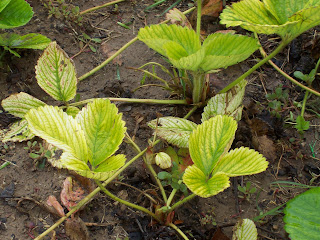 To fix the issue they recommended applying liquid chelated iron fertilizer. Regular iron fertilizer won't work, because the plants are unable to absorb it. Chelated fertilizer comes from organic sources, and is easier for the plants to absorb. After 3 applications of fertilizer over the last six weeks, I have seen a definite improvement in both the strawberries and grapes.
So finally I'm getting a few strawberries to eat this year. Unfortunately, the new problem is that the birds are beating me to most of them. Next year I'm going to have to set up something to keep 'em out of the patch.
 To fix the issue they recommended applying liquid chelated iron fertilizer. Regular iron fertilizer won't work, because the plants are unable to absorb it. Chelated fertilizer comes from organic sources, and is easier for the plants to absorb. After 3 applications of fertilizer over the last six weeks, I have seen a definite improvement in both the strawberries and grapes.
So finally I'm getting a few strawberries to eat this year. Unfortunately, the new problem is that the birds are beating me to most of them. Next year I'm going to have to set up something to keep 'em out of the patch.
Subscribe to:
Posts (Atom)